








Bag filters — also called baghouse dust collectors or fabric filters — are the most widely used dry dust collection technology in modern industry. From cement plants to woodworking shops, they reliably capture particles as small as a fraction of a micron. Yet many buyers and plant engineers only have a vague idea of what actually happens inside the box. In this guide, we break down the complete bag filter working principle step by step: how dusty air enters, how the filter media captures particles, why the dust cake is your best friend, and how pulse jet cleaning keeps the system running 24/7.
- A bag filter separates dust from air by forcing the air stream through permeable fabric filter bags.
- Dust collects on the outside of the bags; clean air passes through the inside and exits the stack.
- The accumulated “dust cake” actually improves filtration efficiency to 99%+ before it is removed.
- Pulse jet cleaning blasts short bursts of compressed air into the bags to dislodge dust without stopping the airflow.
What Is a Bag Filter?
A bag filter (or baghouse) is a dry-type mechanical dust collector that uses woven or felted fabric bags as the filter medium. Dust-laden gas is drawn through the fabric, where particles larger than the fabric’s pores are intercepted and deposited on the bag surface. Cleaned gas then exits through the bag interior to the outlet.
The short answer to “how does a bag filter work?” is this: dirty air in, dust trapped on fabric, clean air out, dust periodically knocked off and discharged. The rest of this article explains each stage in detail.
Main Components of a Bag Filter System
Before walking through the working principle, it helps to know the parts involved. Every industrial bag filter — regardless of manufacturer — contains these core components:
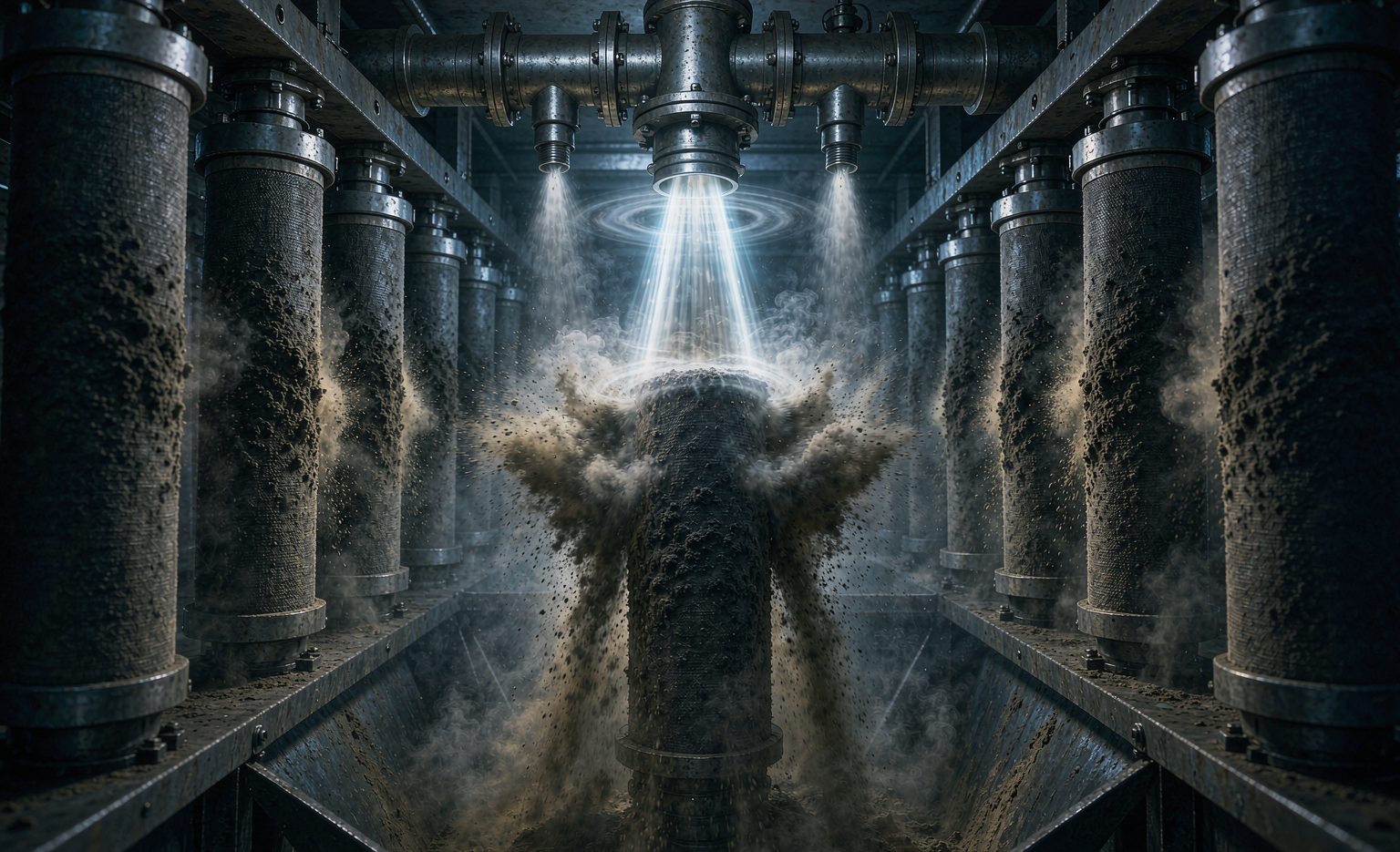
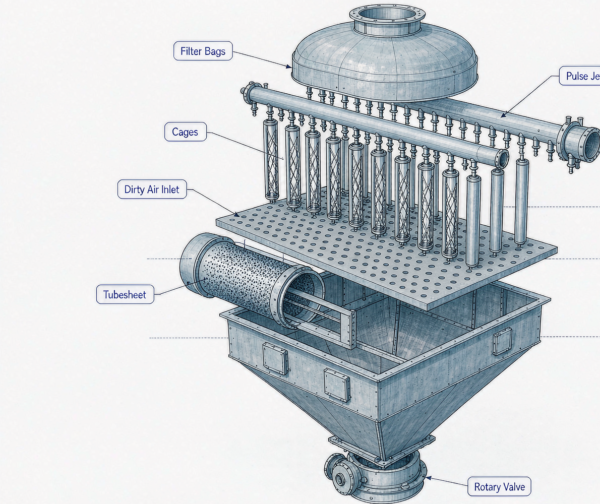
- Housing — the welded steel enclosure that divides the unit into a dirty air plenum, filter compartment and clean air plenum.
- Filter bags — long fabric tubes (typically 120–160 mm in diameter, 2–8 m long) made of polyester, PPS, PTFE, aramid or P84 felt, selected by gas temperature and chemistry.
- Cages — galvanized or stainless wire frames that support the bags, prevent collapse and maintain shape during cleaning pulses.
- Tubesheet — the perforated steel plate at the top of the filter compartment into which each bag-and-cage assembly is sealed. It separates the dirty and clean sides.
- Hopper — the conical bottom section where collected dust falls and accumulates.
- Cleaning system — for pulse jet units, a compressed air manifold with blowpipes, diaphragm valves and a solenoid-controlled timer.
- Dust discharge — rotary valve, screw conveyor or double flap valve that removes dust from the hopper continuously while keeping the system airtight.
Bag Filter Working Principle: Step by Step
Now to the heart of the topic. The working principle of a bag filter can be described in five stages that repeat continuously in a loop.
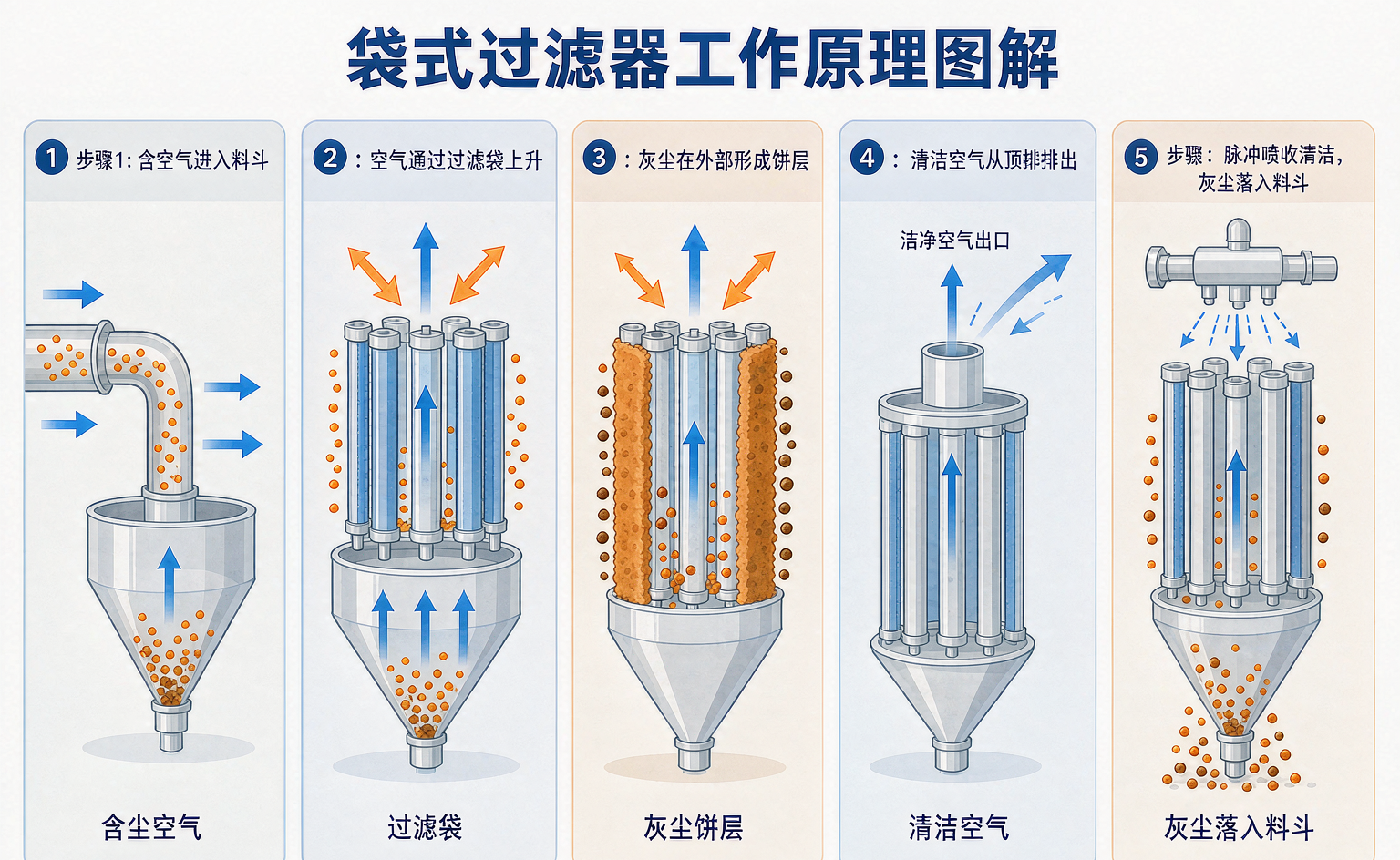
Step 1: Dust-Laden Air Enters the Collector
The process starts at the dust pickup points — hoods over a conveyor transfer chute, a silo vent, a cutter or a mixer. An induced draft fan creates negative pressure that pulls the dusty air through ductwork and into the baghouse. In most pulse jet designs, the air enters through an inlet on the side or bottom, and the sudden expansion of the duct into the large hopper area acts as a preliminary separator: heavier particles slow down and drop directly into the hopper by gravity before reaching the bags. This reduces the load on the filter media.
Step 2: Air Passes Through the Filter Fabric
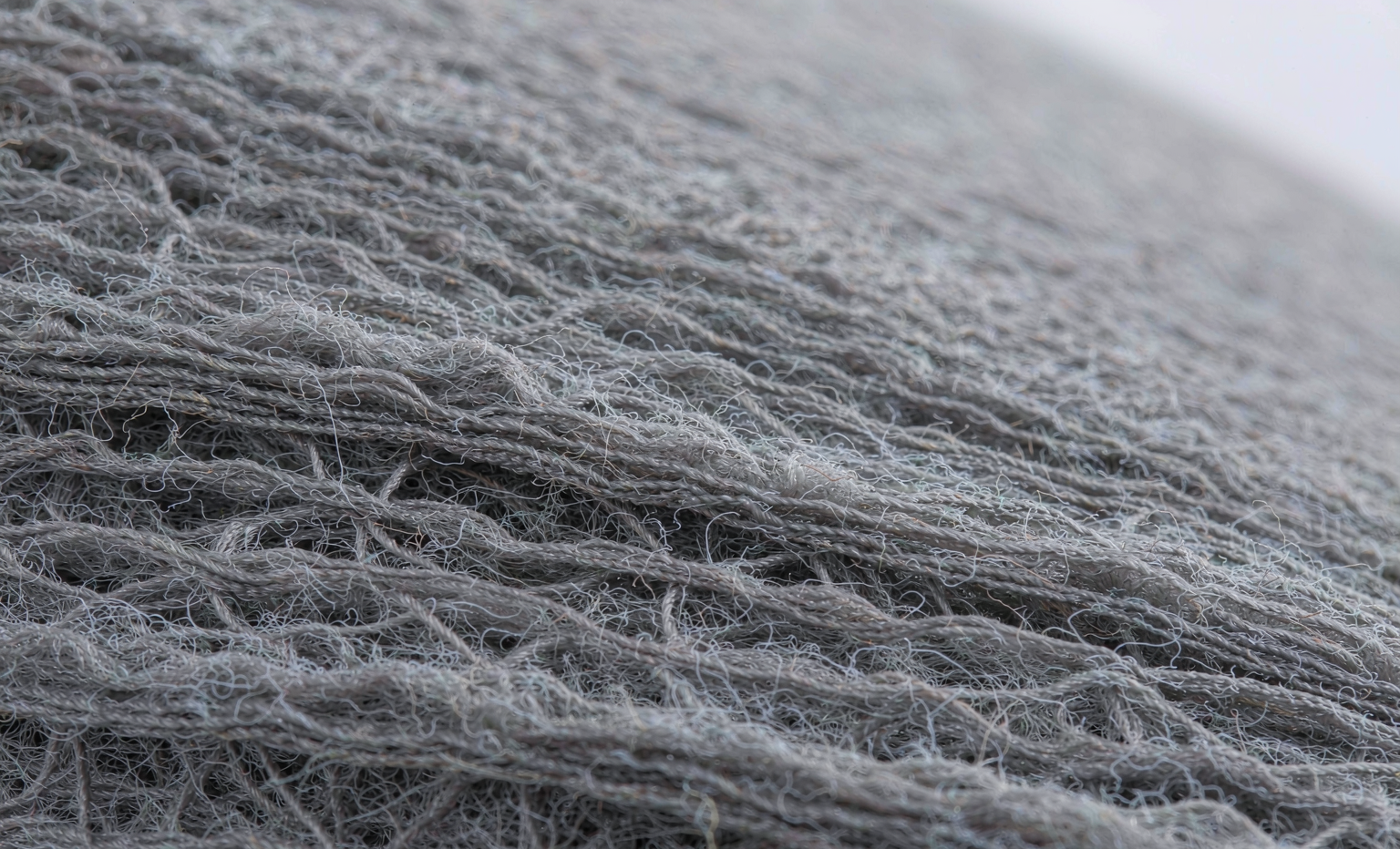
The air stream then flows upward and outward-through — more precisely, into the filter bags. The fabric looks like a solid barrier, but under a microscope it is a dense mat of fibers. Particles are captured by four combined mechanisms:
- Interception — particles following the air streamlines touch a fiber and stick.
- Inertial impaction — larger, heavier particles cannot follow the bending airflow and slam directly into fibers.
- Diffusion — sub-micron particles move randomly (Brownian motion) and eventually collide with fibers.
- Electrostatic attraction — charged particles are pulled onto oppositely charged fiber surfaces.
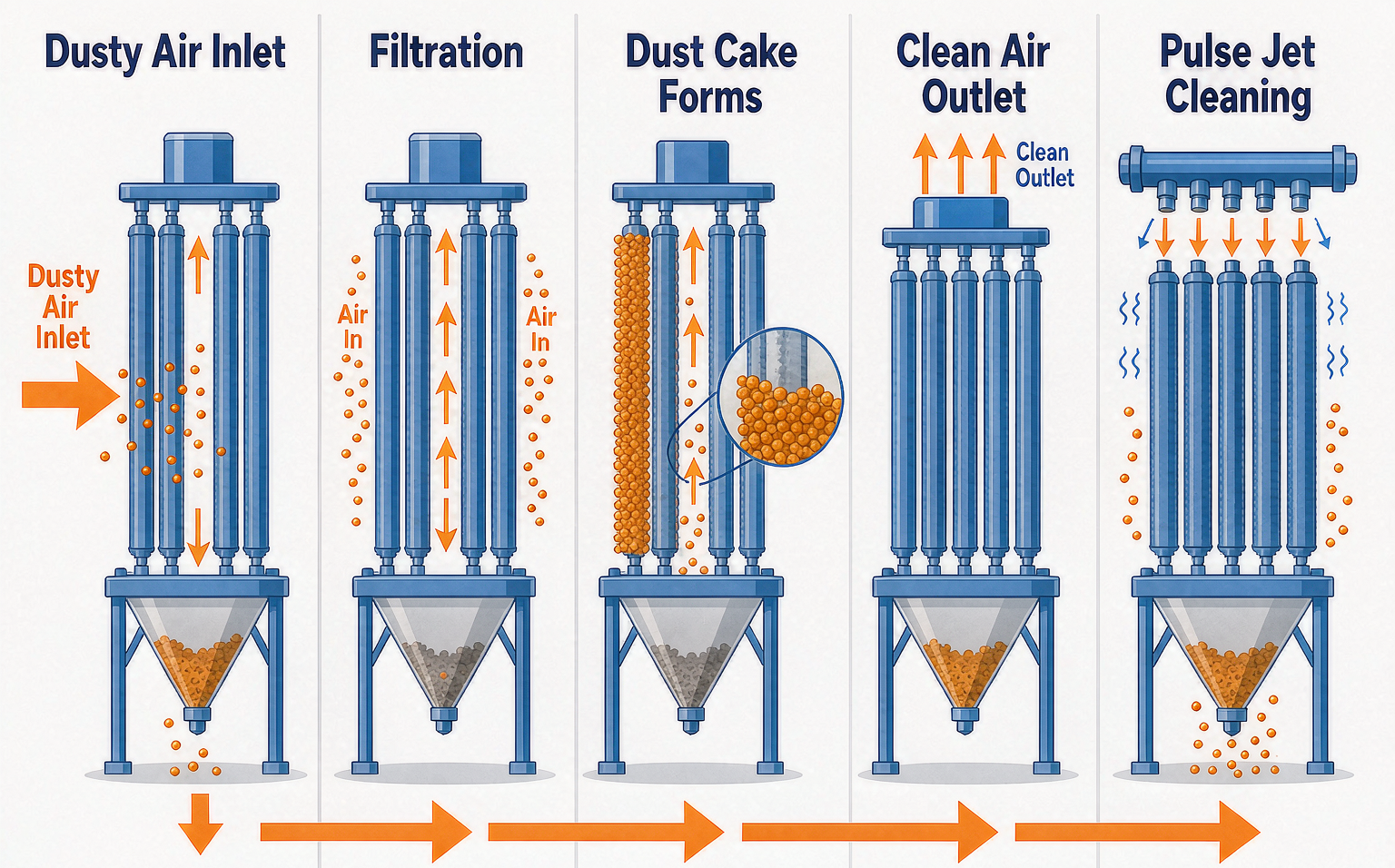
Because of these mechanisms, a well-designed bag filter achieves a collection efficiency of 99.9% or better, even for particles below 1 micron — which is why fabric filters dominate applications with strict PM2.5 emission limits.
Step 3: The Dust Cake Forms — and Improves Filtration
Here is the counterintuitive part of the bag filter working principle. Within seconds of startup, captured particles begin to accumulate on the bag surface. This layer is called the dust cake, and rather than choking the filter, it becomes the actual working filter media: the cake’s fine, porous structure captures new particles far more effectively than the bare fabric ever could. This is why a “seasoned” bag filter can outperform a brand-new one.
The trade-off is pressure drop. As the cake thickens, air resistance rises. A differential pressure gauge across the tubesheet tracks this — typically from around 500 Pa when clean up to 1,200–1,800 Pa when cleaning is required. Managing this cycle is the key to efficient operation.
Step 4: Clean Air Exits Through the Outlet
Filtered air passes through the inside of each bag, up through the tubesheet openings, into the clean air plenum, and finally out the outlet stack to atmosphere or back into the process. In a well-maintained unit, outlet dust concentration is typically below 10–20 mg/m³, easily meeting most international emission standards.
Step 5: Bag Cleaning — Dislodging the Dust Cake
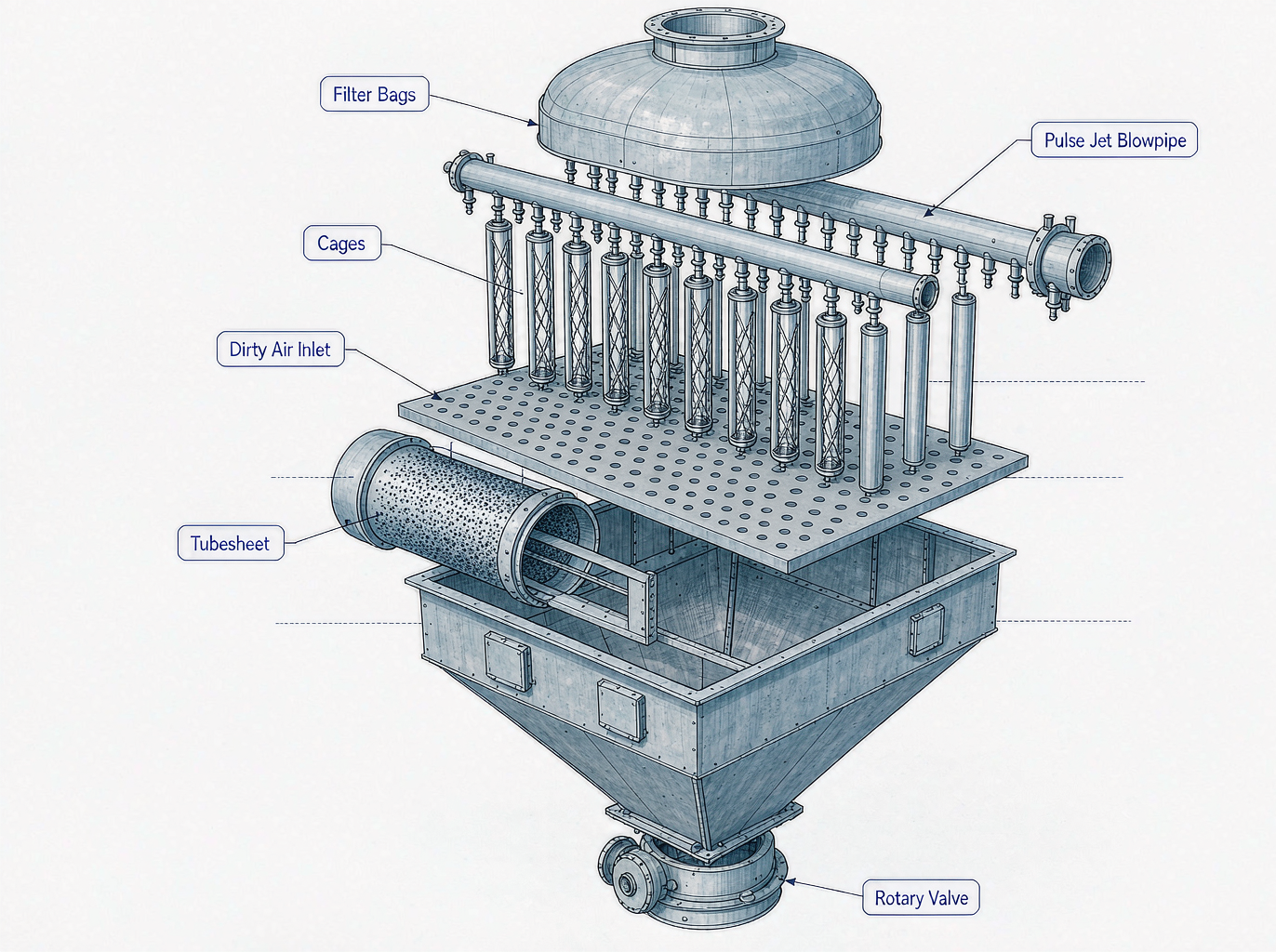
To keep the pressure drop in check, the dust cake must be periodically removed. In pulse jet baghouses — the dominant design today — a timer fires solenoid valves row by row. Each valve releases a short burst (60–100 ms) of high-pressure compressed air (4–6 bar) down a blowpipe positioned above the bags. The blast travels down an injected venturi, creating a shock wave that flexes each bag and throws the dust cake off the fabric surface. Dislodged dust falls into the hopper and is discharged through the rotary valve.
Critically, pulse jet cleaning happens on-line — only one row of bags is being cleaned at any instant while all the others continue filtering, so the process airflow is never interrupted. This is the single biggest reason pulse jet designs displaced older shaker and reverse-air technologies in most industries.
Three Bag Cleaning Methods Compared
While pulse jet is the most common, it helps to know the alternatives:
| Method | How it works | Cleaning intensity | Typical use |
|---|---|---|---|
| Pulse jet | Compressed air bursts fired inside bags via blowpipes | High — works with dense felt media | Cement, steel, power, woodworking (most common) |
| Shaker | Top mechanism mechanically shakes the bags | Medium — requires off-line compartments | Low-temperature, smaller legacy plants |
| Reverse air | Blocked compartment is back-flushed with reverse airflow | Low/gentle — suits fragile woven glass media | Large power plant boilers, high-temperature glass fabric bags |
Filter Media Selection: The Other Half of the Working Principle
The working principle only performs if the media suits the gas. Choosing the wrong fabric is the fastest way to destroy a set of bags. Key selection factors:
- Operating temperature — polyester felt handles up to ~130 °C; PPS to ~190 °C; P84 and PTFE to ~240–260 °C; woven fiberglass with PTFE membrane to ~260 °C.
- Chemistry — acid dew point, moisture and oxygen content rule out certain fibers (for example, PPS degrades in high-oxygen flue gas).
- Abrasion — high dust velocity or angular particles call for heavier GSM felt (550–650 g/m²) and abrasion-resistant finishes.
- Surface treatment — PTFE membranes, anti-static and water/oil repellent finishes modify how the cake forms and releases.
Where Bag Filters Are Used
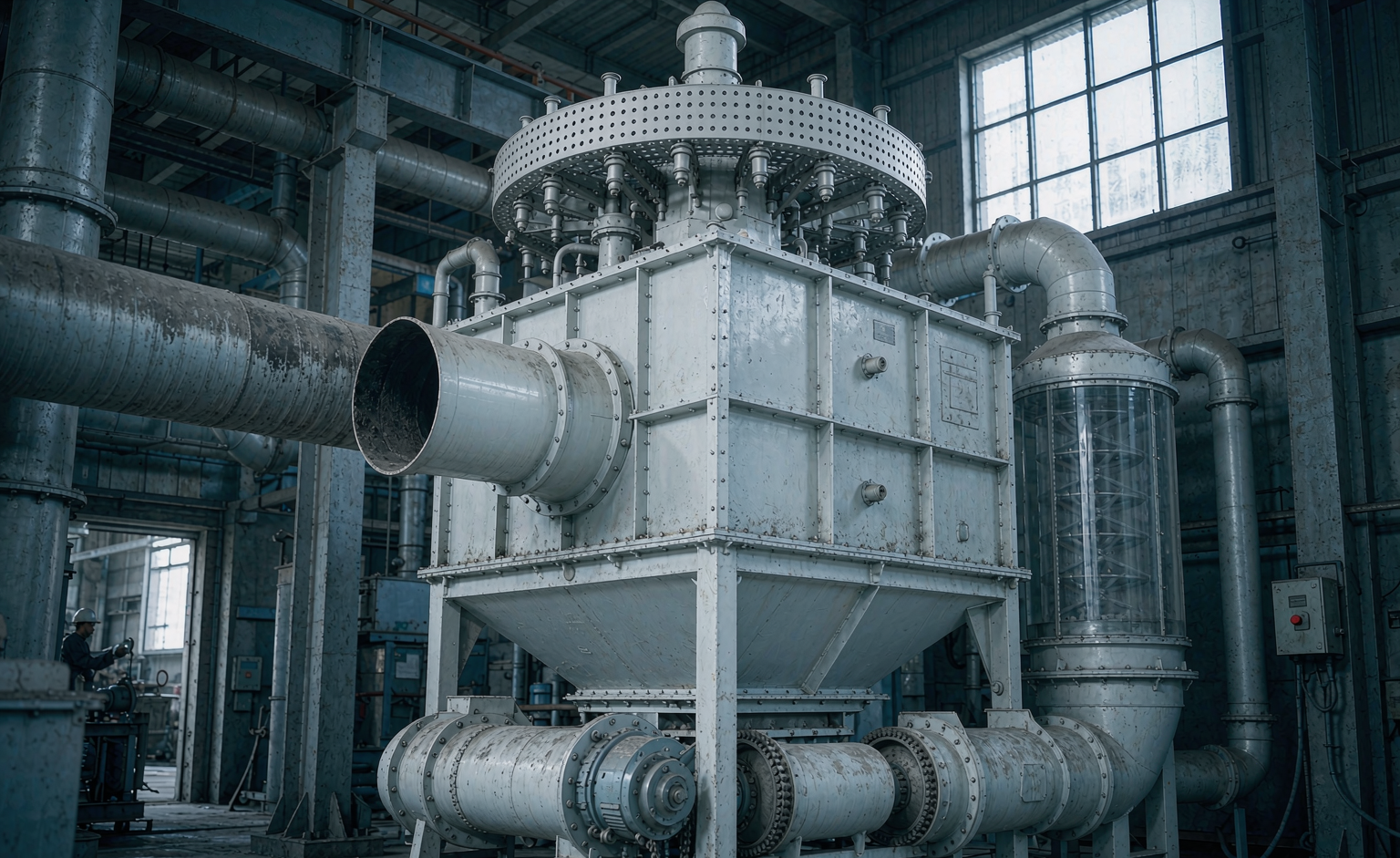
Bag filters are the default choice wherever dry particulate must be captured at high efficiency:
- Cement & lime — kiln exhaust, raw mill, clinker cooler venting.
- Steel & foundry — electric arc furnace fume, blast furnace cast house, shot blasting.
- Power generation — coal boiler flue gas (often combined with SCR/FGD).
- Woodworking & furniture — sanding dust, planer shavings, CNC router extraction.
- Food, pharma & chemical — pneumatic conveying vents, spray dryers, mixers.
- Mining & bulk handling — crusher venting, silo bins, truck loading spouts.
Advantages and Limitations of Bag Filters
| Advantages | Limitations |
|---|---|
|
|
Bag Filter Maintenance: Keeping the Principle Working
The working principle depends on healthy bags and stable pressure drop. A practical maintenance routine includes:
- Monitor differential pressure daily — a sudden drop suggests a torn bag or leaking tubesheet seal; a steady climb suggests blinded media or a failed cleaning valve.
- Inspect cleaning system weekly — listen for leaking diaphragm valves and check compressed air quality (dry, oil-free).
- Check hopper discharge — dust bridging or a stuck rotary valve will re-entrain dust and blind the bags quickly.
- Sample bags annually — pull a few bags and check cake release, abrasion at cage wires, and flex cracks near the top cap.
- Replace bags in full sets — mixing old and new bags causes uneven airflow distribution and shortens new-bag life.
Bag Filter Working Principle: FAQ
What is the working principle of a bag filter in simple terms?
A fan pulls dusty air into a chamber full of fabric bags. Dust sticks to the outside of the bags while clean air passes through and exits. Compressed air pulses periodically knock the accumulated dust off the bags, and it falls into a hopper for discharge.
What is the filtration efficiency of a bag filter?
Modern pulse jet bag filters routinely achieve 99.9% or higher collection efficiency, and can reduce outlet emissions to below 10 mg/m³ — sufficient for the strictest PM2.5 regulations.
Why is the dust cake important in a bag filter?
The dust cake is the layer of dust that builds up on the outside of the bags. It acts as the true filter media, capturing particles far more effectively than bare fabric. It is removed only when the pressure drop becomes too high.
How often should filter bags be replaced?
Bag life depends on the application: typically 2–4 years in general industry, and 1–2 years in aggressive environments such as cement kilns or high-temperature flue gas. Replace in full sets, not individually.
What is the difference between a bag filter and a cartridge filter?
Both are fabric-style dry collectors, but cartridge filters use pleated media with much larger surface area in a compact housing, suited to fine, low-concentration dust. Bag filters handle higher dust loads, higher temperatures and more abrasive media — which is why heavy industry still relies primarily on baghouses.
Conclusion
The bag filter working principle is elegantly simple — trap dust on fabric, clean the fabric automatically, discharge the dust — yet behind that simplicity sits a carefully engineered balance of gas velocity, pressure drop, media selection and cleaning energy. Get that balance right, and a baghouse will quietly deliver 99.9% clean air for years with only routine maintenance.
Need help sizing or specifying a bag filter for your application? Contact our engineering team for a free dust collection assessment — or browse our industrial bag filter product range to compare models.
